Rules
Dart games to play at home: Killer, Shanghai, Golf and more
Rules for classic dart games to play at home: Around the Clock, Killer, Shanghai, Halve-It, Bob's 27, Baseball and Golf, for two players or a group.
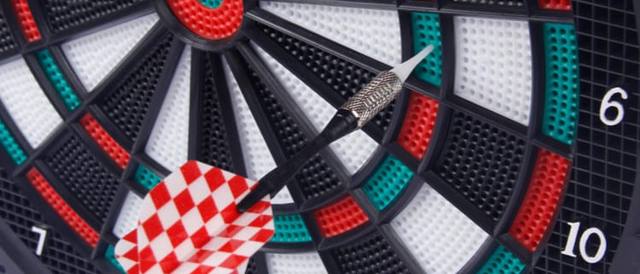
The best dart games for home are short, need little or no adding up and give everyone a turn quickly. Around the Clock suits beginners, Killer suits a group, Shanghai, Golf and Baseball suit two players, and Bob's 27 is the classic practice game on your own. This guide gives the common rules for seven classic games and points out where pubs and families tend to play their own versions.
Which game for how many players?
| Game | Players | Best for | Skill needed |
|---|---|---|---|
| Around the Clock | 1 or more | beginners, children, warming up | low |
| Killer | 3 or more is best, 2 works | parties and groups | medium |
| Shanghai | 2 or more | quick games, groups | medium |
| Halve-It | 1 or more | practice, friendly pressure | medium |
| Bob's 27 | 1 | practising doubles | high |
| Baseball | 2 or more, or teams | beginners, team games | low |
| Golf | 1 or more | two players, beginners | low to medium |
| Cricket | 2, or two teams | two players | medium |
| 501 or 301 | 2 or more | the standard match game | medium to high |
Before you start: agree the house rules
Apart from 501, most of these games have no single rulebook. The versions below are the ones described by darts makers and specialist shops, but pubs and families often add their own twists. Before the first dart, agree:
- the version you are playing, especially for Killer and Around the Clock,
- the order of play. A simple way is for everyone to throw one dart at the bull, and the closest goes first,
- bounce-outs. In match play a dart that falls out of the board scores nothing.
Everyone throws three darts per turn unless the game says otherwise.
Around the Clock
- Throw at the 1. Once you hit it, move on to the 2, then the 3, all the way to 20.
- You cannot move on until you have hit the number you are on.
- The first player to hit the 20 wins. Many people add the outer bull and the bull at the end, and finish on the bull.
House rules differ on doubles and trebles. In some versions they count the same as a single. In others a double or treble moves you further round the board, which speeds the game up. For a harder practice game, count only doubles or only trebles.
Killer
Killer is the pub favourite for a group and has the most local variations. A common version:
- Claim a number. Each player throws one dart with their weaker hand. The number it lands in is theirs. If you miss, or the number is taken, throw again.
- Build up lives. Throw at your own number. A single gives you one life, a double two and a treble three. With three lives you become a killer.
- Take lives. As a killer, hit another player's number to take lives from them, at the same rate: one for a single, two for a double, three for a treble.
- Watch your own number. Hit it by mistake while aiming at a neighbour and you lose lives. Drop below three and you stop being a killer until you have won them back.
- Knock players out. A player on zero lives is out when a killer hits their number again. The last player with lives left wins.
Common variations:
- Doubles only. You hit your own double three times to become a killer, and each hit on a rival's double costs them a life. Players often start with three to five lives.
- Five lives. Some pubs play to five lives, and you must hit exactly five to become a killer.
- Blind Killer. Numbers are drawn in secret, so nobody knows whose number they are hitting.
- Straight off. Everyone starts as a killer, which makes for a much quicker game.
Shanghai
- In round one everyone throws at the 1, in round two at the 2, and so on. Play 1 to 7 for a short game or 1 to 20 for a long one.
- Only hits on that round's number score: a single scores the number, a double twice the number and a treble three times the number.
- If you hit a single, a double and a treble of the round's number in one turn, that is a Shanghai and you win on the spot. In the most popular version the order does not matter, but some groups insist on a set order.
- If nobody hits a Shanghai, the highest total after the last round wins.
Halve-It
Halve-It puts pressure on every turn, which makes it good practice for match nerves.
- Agree six targets before you start and write them down the side of the scoreboard. For example: 20, 19, any double, 18, any treble, bull.
- In each round every player throws three darts at that round's target. Hits score their value.
- If you score nothing on the target in your turn, your running total is halved. Agree in advance whether to round an odd half up or down.
- The highest total after the last target wins.
Change the targets to make it easier or harder, or to work on a weak number.
Bob's 27
A practice game for doubles, devised by former world champion Bob Anderson.
- Start on 27 points.
- Throw three darts at double 1, then three at double 2, and so on up to double 20. Some players finish with three darts at the bull.
- Every dart in the double adds that double's value: 2 for double 1, 40 for double 20.
- If all three darts miss, subtract the double's value.
- Aim to finish above zero. In the strict version the game ends as soon as you drop below zero.
The low doubles are worth little, so a few misses early on can wipe out your 27 points. Keep your scores and try to beat them.
Baseball
- The game has nine innings. In the first innings everyone throws at the 1, in the second at the 2, up to the 9.
- Each player throws three darts per innings. A single scores one run, a double two runs and a treble three.
- The most runs after nine innings wins, so the most you can score is 81. A tie can be settled with extra innings, often at the bull.
Golf
- Play nine holes (the numbers 1 to 9) or eighteen (1 to 18), one number per hole.
- On each hole you have up to three darts. You can stop after any of them, but only your last dart counts, so throwing again can also make things worse.
- A common scoring system: a double is 1 stroke, a treble 2, a single 3 and a miss 5. Some players score the treble as 1 and the double as 2, so agree which before you tee off.
- The lowest total after the last hole wins.
501 and Cricket
501 is the standard match game, and 301 is a shorter version for a quick leg. Our guide to dartboard scoring explains doubles, trebles, the double finish, the bust rule and the checkouts worth learning.
Cricket is the classic two-player tactical game, played on 15 to 20 and the bull. See cricket darts rules for marks, scoring and the cut-throat version for three or more.
Playing on an electronic board
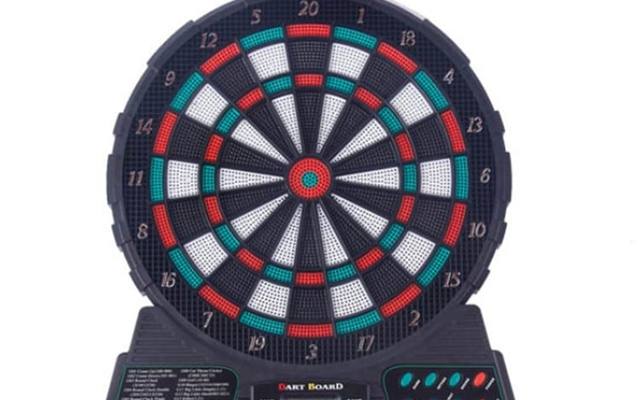
An electronic board does the adding up for you. Our 12 inch electronic dartboard keeps the score on an LCD display, and buttons next to the display choose the game and the options. Check the English manual for the games it offers and how it scores them, as built-in versions may differ from the rules above. It is a compact board for fun and small rooms rather than league practice, and comes with six soft-tip darts. Use soft tips only. See all our electronic dartboards.
Darts for a group
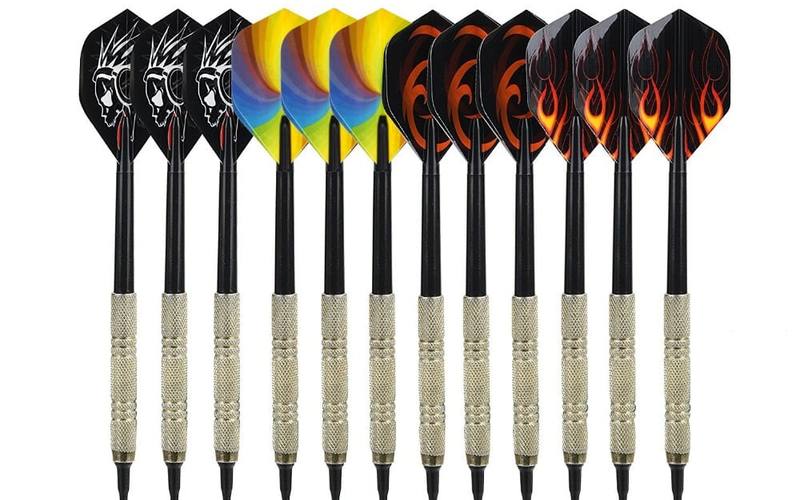
Games are more fun when everyone has their own three darts. For an electronic board, our set of 12 soft-tip darts is enough for four players, with 30 spare flights and 100 spare tips. The supplier marks them as not suitable for children under 14. For a bristle board, the 22 g steel-tip darts, set of 6, give two players a set of three each. See all our darts.
Whichever game you play, only one person throws at a time and everyone else stands behind the thrower.
Frequently asked questions
What are the best dart games for two players?
Cricket, Shanghai, Golf and Baseball all work well with two. Cricket rewards accuracy on 15 to 20 and the bull, Shanghai and Baseball are quick races through the numbers, and Golf is easy to learn because only your last dart on each hole counts. Halve-It is another good choice if you both want a bit of pressure on every turn.
How do you play Killer darts?
Each player throws one dart with their weaker hand to claim a number. You then throw at your own number to build up lives: in a common version a single is worth one life, a double two and a treble three, and three lives make you a killer. As a killer you take lives by hitting other players' numbers. Hit your own number by mistake and you lose lives. The last player with lives left wins. Pubs play many variations, such as doubles only, so agree the rules first.
What is a good dart game for beginners?
Around the Clock is the usual first game: hit the numbers 1 to 20 in order, with no adding up. Golf and Baseball are also easy, because each turn has a single target and the scoring is simple. Children should only play with an adult watching, and you should check the age marking on any set of darts before you buy.
What dart games can you play on your own?
Around the Clock, Bob's 27, Halve-It and Golf all work as solo practice. Keep a note of your score or the number of darts you needed, and try to beat it next time. Bob's 27 is aimed at doubles, so it is a good one if you lose legs of 501 at the finish.