Technique
How to throw darts: grip, stance, aim and release
How to throw darts more accurately: how to hold a dart, where to stand at the oche, how to aim, a steady release and follow-through, and drills for home.
A good darts throw is not about power. It is about doing the same simple movement the same way, dart after dart. Players at every level hold the dart differently and stand slightly differently, but the good ones share a few things: a stable stance, a light grip, a steady elbow and a follow-through towards the target. This guide covers each part, in the order you set it up at the oche.
Start with the rules
The rules shape the throw more than most people realise. Under the World Darts Federation (WDF) playing rules:
- darts are thrown deliberately, one at a time, by and from the hand,
- your feet must be behind the oche when you throw, and you may not tread on a raised oche,
- a dart that bounces out or falls out of the board does not count and cannot be thrown again.
The Darts Regulation Authority (DRA) rules, used at professional events in the UK, say the same about the hand and bounce-outs, and require the front foot to be on the floor behind the toe edge of the raised oche. The rules only govern your feet. Leaning forward over the line is allowed.
The standard distances are a bull 1.73 m above the floor and a throw line 2.37 m from the face of the board, with a diagonal of 2.93 m from the bull to the back of the line. Our guide to dartboard height and oche distance shows how to measure them.
Stance: where to put your feet
Darts Corner, a UK darts retailer, describes the basic stance like this: the dominant foot goes in front, so the right foot for a right-handed player, and most of your weight rests on it. DARTSLIVE, which makes electronic boards, gives the same advice: the foot on the side of your throwing hand steps forward.
From there, a few details:
- Angle your front foot along the line or slightly towards the board, whichever feels stable. Many players stand side-on, some more square. Pick what lets you keep still.
- Keep the back foot down for balance, with the heel lifted if that is comfortable.
- Lean a little, but not so far that you wobble.
- Keep everything still except the throwing arm. Darts Corner's advice is to keep the rest of your body as still as possible.
Use the same spot on the line every time. A strip of tape at your toe position helps when you are learning.
Grip: how to hold a dart
Most players grip the dart with three fingers: thumb, forefinger and middle finger. Some use four, and a few hold it like a pencil with two. There is no single correct grip, but there are a few rules of thumb:
- Hold the barrel, not the shaft, around its middle. Darts Corner suggests holding the dart in the centre of the barrel.
- Find the balance point. Rest the dart on one finger and slide it until it balances. Your thumb usually sits on or just behind that point.
- Grip lightly. Darts Corner warns against gripping too tightly. If your fingertips go white, relax them.
- Keep the point level or slightly up as you take aim. This is a matter of style, so try both and keep what groups best.
The barrel shape affects how a grip feels. A straight barrel lets you hold it anywhere, while front-weighted barrels suit players who hold near the front. Our guide to dart weights explains the differences.
Aim: line up eye, dart and target
- Look at a precise spot, such as the middle of treble 20, not the general area.
- Line the dart up with your eye and the target. Many players bring the dart up near the eye so the line is easy to see.
- Keep your head still through the throw.
- Aim with your dominant eye. To find it, point at a distant object with both eyes open, then close one eye. If your finger stays on the object, the open eye is your dominant one.
The throw: take-back, release and follow-through
1. Take-back. Draw the dart back towards your face in a smooth, straight line. How far is personal; what matters is that it is the same every time.
2. Keep the elbow steady. The elbow acts as the pivot. Darts Corner points out that it is much harder to be consistent if you drop or raise the elbow during the throw. Keep it steady while you learn.
3. Release. Move the forearm, wrist and hand forward smoothly and let the dart go. Do not push or snatch. The dart should leave your fingers on the line you aimed along.
4. Follow through. Finish with your arm reaching towards the board and, in Darts Corner's words, your fingertips pointing towards the target. Hold that position for a moment. A short follow-through is one of the most common reasons darts drop low.
Above all, aim for a throw you can repeat. Darts Corner's advice is to develop a throw you can easily replicate, and that matters more than copying anyone else's style.
Common faults and what to check
| What happens | What to check |
|---|---|
| Darts land low | elbow dropping, early release, short follow-through |
| Darts land high | elbow rising early, releasing late |
| Darts drift left or right | body moving, elbow swinging out, feet changing position |
| Darts land at odd angles | grip too tight, pushing the dart, flights or shafts damaged |
| Groups spread out after a few throws | rushing; slow down and reset between darts |
Practice drills at home
- Round the board. Hit 1 to 20 in order, then the bull. Count the darts you need and try to beat it.
- Twenty darts at 20. Throw at treble 20 and add up the score. Record it each session.
- Doubles. Pick one double and keep throwing until you hit it three times.
- Bull finish. End every session with nine darts at the bull.
Short, regular sessions beat one long one. Ten to twenty minutes most days builds a repeatable throw faster than two hours at the weekend. For a game to practise with friends, try cricket.
Darts that suit your throw
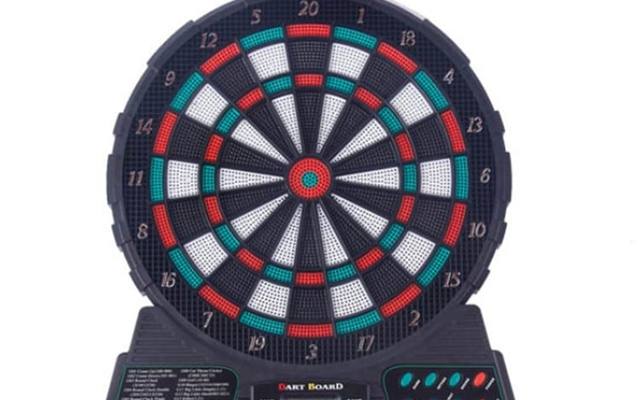
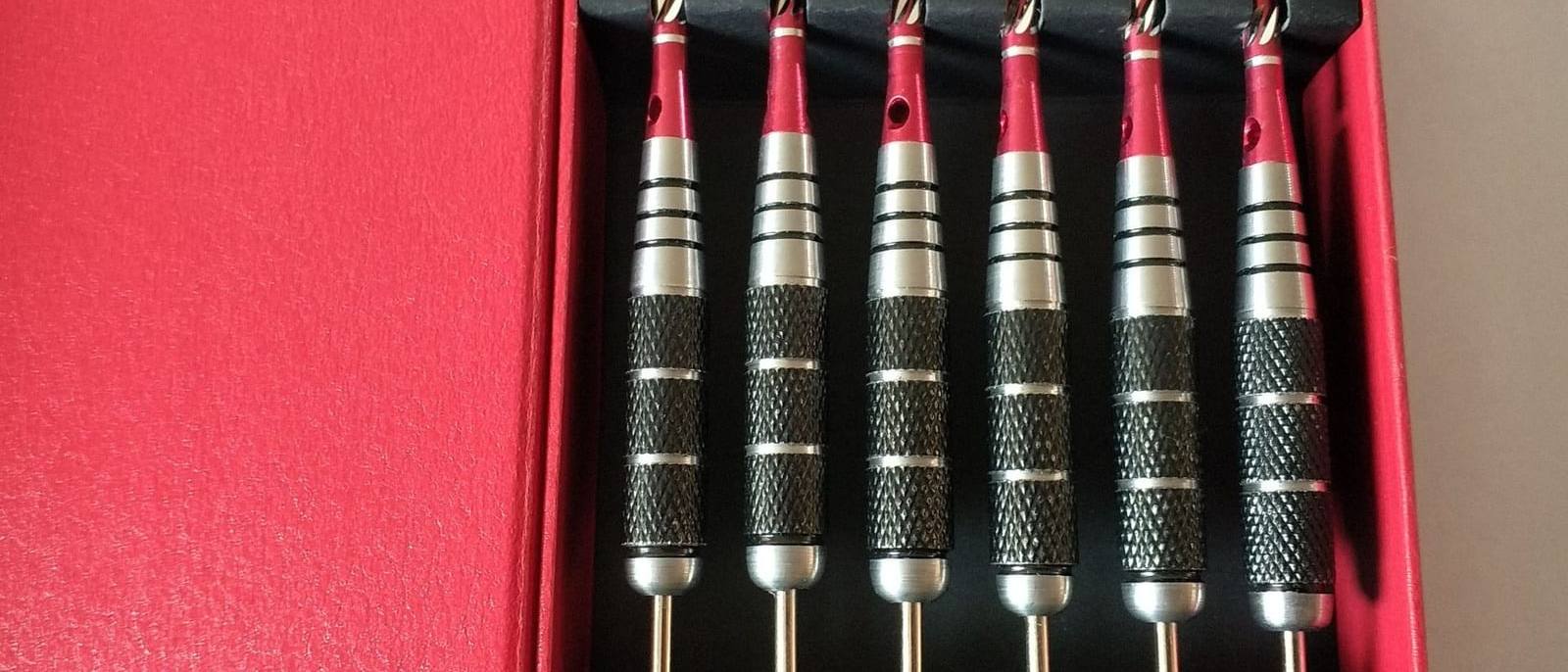
Beginners often find a mid-weight dart easiest to control. Our 22 g steel-tip darts, set of 6, have straight stainless steel barrels of 9 mm with grip rings, so you can try different hand positions on the same dart. For an electronic board, the soft-tip darts with a hard case have grooved barrels that are easy to grip. Use steel tips only on a bristle board and soft tips on an electronic board. See all our darts.
Safety at home
- Only one person throws at a time; everyone else stands behind the thrower.
- Walk up and collect darts together, and never throw while someone is near the board.
- Pull darts out with a slight twist rather than levering them.
- Keep darts out of reach of young children.
Frequently asked questions
How should I hold a dart?
Most players hold the dart with three fingers: the thumb, the forefinger and the middle finger. Hold it around the middle of the barrel, close to its balance point, and grip it lightly. A tight grip makes a clean release harder.
Which foot goes forward when throwing darts?
The foot on the same side as your throwing hand, so the right foot for a right-handed player. Put most of your weight on it and keep the toe behind the throw line.
Can you lean over the oche in darts?
Yes. The rules control where your feet are, not your body. Your feet must stay behind the raised oche or throw line, but you may lean forward as far as your balance allows.
Why do my darts keep going low?
The most common causes are dropping the elbow during the throw, letting go too early and cutting the follow-through short. Keep the elbow steady and finish with your fingertips pointing at the target.
How far do you stand from a dartboard?
For steel-tip darts the throw line is 2.37 m from the face of the board, with the bull 1.73 m above the floor. Many soft-tip electronic boards use about 2.44 m, so check the manual.