Buying advice
What weight darts should I use? A guide to dart weights
What weight darts to choose: legal limits, the usual steel-tip and soft-tip range, what the box weight means, and how barrel material and shape change the feel.
Walk into a darts shop or scroll through a website and the numbers jump out first: 18 g, 22 g, 24 g, 26 g. Weight is the first choice most players make, and it does make a difference to how a dart feels in the hand and in the air. It is not the only thing that matters, though. Barrel material, shape and grip change the feel as much as a gram or two. This guide explains the limits, the usual range and how to choose.
The short answer
- New to darts: start around 22 to 24 g steel tip. Target suggests 22 g or 23 g as a starting point, and Harrows suggests 22 to 24 g.
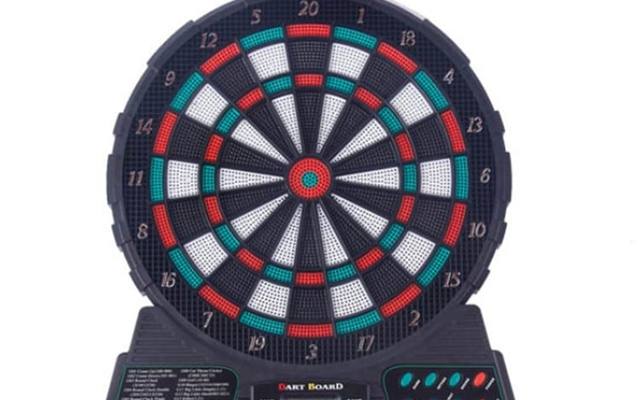
- Electronic board: soft-tip darts are lighter, typically up to 18 to 20 g, because most boards and leagues set a limit. Check your board's manual.
- Already playing: change weight in small steps of 1 or 2 g, and only one thing at a time.
The rules: how heavy can a dart be?
There are two sets of rules you will see quoted in the UK:
| Rules | Maximum weight | Maximum length |
|---|---|---|
| World Darts Federation (WDF), steel tip | 50 g | 30.5 cm |
| Darts Regulation Authority (DRA), steel tip | 40 g | 200 mm |
The DRA rules apply at professional events. Either way, the limits are far above what almost anyone throws, so they rarely matter at home or in a local league.
Soft-tip darts have no single standard. Electronic boards and soft-tip leagues set their own limits, mostly around 18 to 20 g. The US National Dart Association, for example, has allowed 20 g darts in its tournaments since June 2015. If your board's manual gives a limit, stick to it.
What weight do most people throw?
The darts maker Target says steel-tip darts typically range from 18 to 26 g, with the most popular options between 20 and 24 g. Harrows puts most steel-tip darts between 20 and 26 g. Heavier and lighter darts exist, but most players end up somewhere in that band.
What the number on the box means
For steel-tip darts, the weight on the box usually refers to the barrel, the metal part you hold, with its point. Harrows explains that the complete dart is heavier once the shaft and flight are added. For soft-tip darts, the stated weight often refers to the whole dart.
Our 22 g steel-tip darts are listed the other way round: each complete dart weighs 22 g, with a barrel of about 20 g. When you compare darts, check which figure a seller gives.
Heavy or light: how it feels
Harrows describes the difference like this:
| Lighter darts (18 to 21 g) | Heavier darts (25 g and up) | |
|---|---|---|
| Effort | need a bit more push to reach the board | carry their own momentum and fly with less effort |
| Suits | a faster, flatter throwing action | many players find they calm a shaky throw |
| Watch out for | more affected by a slightly off release, less forgiving for a beginner | too much weight can drag the nose down if your action is too gentle |
In between, the 22 to 24 g range is, in Harrows' words, heavy enough to fly with a stable, predictable arc, which is why it is the usual starting point. Target also suggests that beginners start with a slightly heavier dart for stability and control. These are tendencies, not rules. The only real test is to throw several weights at the board and see which one groups tightest for you.
Barrel material: tungsten, nickel silver, brass and steel
The material decides how thick the barrel is for a given weight.
- Tungsten is very dense, so a tungsten barrel is slim for its weight. Harrows explains that the higher the tungsten percentage, the denser the metal and the slimmer the barrel can be for the same weight. Target lists tungsten content from about 80% up to 97.5%, and says the slimmer barrel allows tighter groupings.
- Nickel silver sits between tungsten and brass, in Target's words striking a balance between the two.
- Brass is the cheapest. Target notes that brass darts are more affordable but tend to be bulkier, and Harrows says a brass dart of the same weight is much thicker.
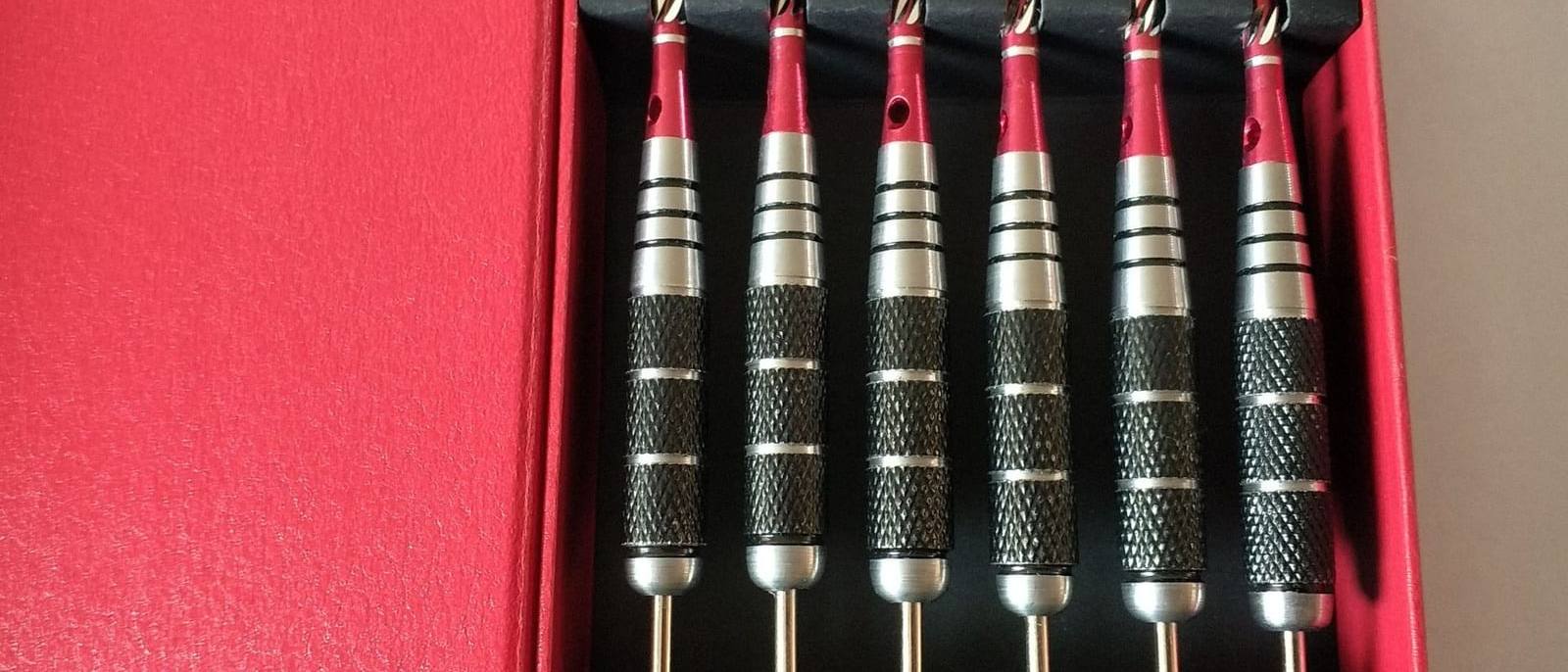
- Stainless steel is used on some starter sets, including ours: our 22 g darts have straight stainless steel barrels, 9 mm across. A tungsten barrel of the same weight would be slimmer, but it costs more.
Barrel shape and balance
Where the weight sits along the barrel changes the feel as much as the total.
- Front-weighted or front-loaded barrels have most of the weight towards the point. Darts Corner says they work better for players who hold the dart near the front.
- Torpedo barrels are a front-weighted shape. Darts Corner describes their weight as centred in the front of the barrel.
- Straight barrels spread the weight evenly. Darts Corner says they can be used for any style of play, which makes them a good first choice.
- Rear-weighted barrels suit players who hold the dart closer to the back.
The grip pattern matters too: rings, grooves or knurling give the fingers something to hold, and a smooth barrel slides more. Our guide to throwing darts explains how to find the balance point and set your grip.
Soft-tip darts for electronic boards
Soft-tip darts have plastic points that go into the holes of an electronic board. They must stay within the board's weight limit, and steel tips must never be used on an electronic board. Our set of 12 soft-tip darts is made for family games, with 30 spare flights and 100 spare tips. The set of 3 soft-tip darts with a hard case has black grooved barrels and a slim case. The supplier does not give the weight of one dart for either set, so if your board has a strict limit, email us and we will check.
How to choose your weight
- Start in the middle. Pick something around 22 to 24 g.
- Borrow and try. Throw friends' darts or the club's spares. Ten throws at the treble 20 with each weight tell you more than any chart.
- Change one thing at a time. Weight, barrel shape and shaft length all change the feel. Swap only one, or you will not know what helped.
- Give it a week. Any new dart can feel strange for the first few sessions.
- Check the grouping, not the single best dart. The right weight is the one where your three darts land closest together most often.
Do darts need to match?
Yes, within a set. Your three darts should be the same weight, shape and set-up, so every throw behaves the same. A second set of a different weight is useful for testing, but do not mix them in a game.
See all our darts for steel-tip and soft-tip sets.
Frequently asked questions
What is the best dart weight for a beginner?
Most makers suggest starting in the low to mid 20s. Target suggests 22 g or 23 g as a starting point, and Harrows suggests a weight between 22 and 24 g. Throw a few sets if you can, and keep the weight that groups best for you.
Are heavier darts more accurate?
Not in themselves. Harrows says heavier darts carry their own momentum and that many players find a heavier dart calms a shaky throw, while lighter darts suit a faster, flatter action but are more affected by a slightly off release. Accuracy comes from a repeatable throw, so the right weight is the one that suits yours.
What is the maximum weight of a dart?
Under World Darts Federation rules a steel-tip dart may weigh up to 50 g and be up to 30.5 cm long. The Darts Regulation Authority rules used at professional events in the UK set 40 g and 200 mm. Soft-tip darts are usually limited to about 18 to 20 g by electronic boards and leagues.
Does the weight on the box include the flight and shaft?
For steel-tip darts it usually means the barrel with its point. Harrows explains that the stated weight refers to the barrel, and the complete dart is heavier once the shaft and flight are on. For soft-tip darts the weight often refers to the whole dart. Check the listing to be sure.